Cities
New York after dark: a city that runs on stamina and access
New York's night is organised by stamina and access, not by district. What a 4am licence changes, Manhattan against Brooklyn, and the legal position.
7 min read
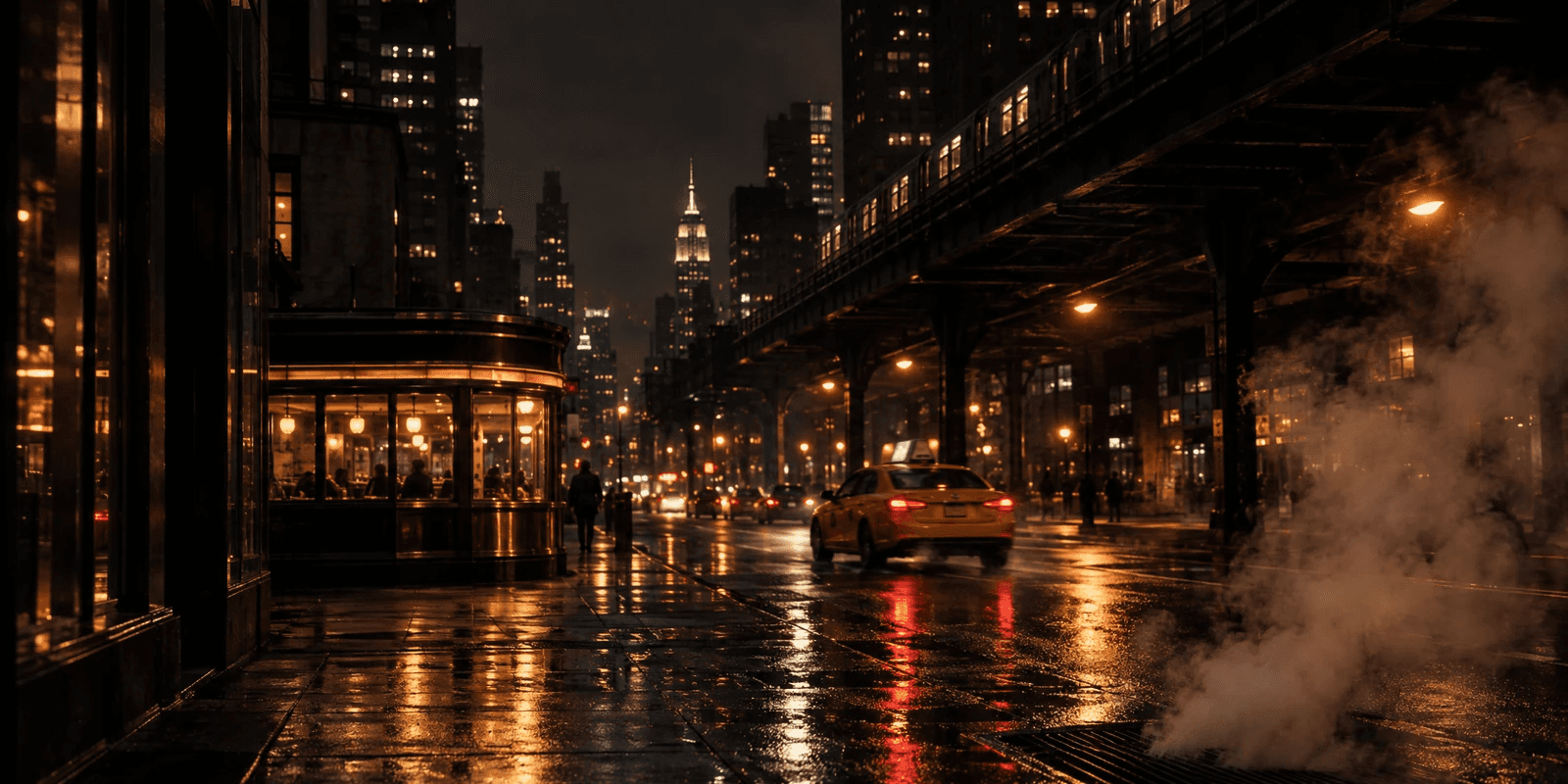
New York’s night is not organised by neighbourhood. It is organised by stamina and access: how late you can still be upright, and whether the room you want will let you into it. Get those two right and the geography arranges itself. Get them wrong and you can spend an entire evening in the correct postcode, three metres from a door, learning nothing at all.
That is the short answer. The long one starts with a licence.
What a 4am licence actually changes
Bars in New York City serve until four in the morning. Not occasionally, not by special application, not behind a members’ door. Four, as the ordinary closing time of an ordinary bar, on a Tuesday.
That single fact shapes an evening more than any amount of glamour does. Most European capitals build the night as a funnel: everything narrows towards last orders, and the hours before it are spent positioning yourself for what comes after, because after is expensive, private and difficult to get into. London is built almost entirely this way. New York has no funnel. It has a long flat plateau that starts around eleven and does not begin to slope until half past three.
So nothing is urgent and everything takes longer. Dinner at nine is early. Arriving somewhere at one in the morning is arriving, not arriving late. The city sorts people by endurance rather than by entrance. It does not much care how well you present at ten o’clock; it cares what you are like at two, which is a harder examination and a more honest one.
Eat more than you think you need to. That is the whole technique.
Manhattan or Brooklyn after midnight
Two different propositions, and the difference is not quality. It is what the room wants from you.
Manhattan after midnight is dense and hierarchical. The Lower East Side holds the highest concentration of small rooms in the city: Ludlow, Orchard and Rivington within a few blocks, doors two metres apart, a queue outside one and nobody outside the next. It rewards movement. You are supposed to leave a place slightly before it peaks, which is a skill, and locals have it.
The Meatpacking District runs the other way. Gansevoort and Washington after one in the morning is the most openly stratified stretch of nightlife here: lists, bottle minimums, hotel rooftops along the High Line, and a door culture that decides in three seconds and is rarely wrong about what it has decided. It is not subtle and does not pretend to be. There is a certain relief in that.
Brooklyn is twenty minutes away on the L and inverts the arrangement. Williamsburg is Manhattan’s confidence with the price tag filed down: Wythe Avenue, rooftops facing the skyline, bars along Bedford that stay full until close, a crowd that dressed carefully and would like you to think otherwise. Bushwick, out around the Jefferson and Morgan stops, is where the night stops performing for anybody. Warehouse rooms, no frontage worth the name, a queue of people who came for what is inside rather than to have been seen outside.
Manhattan asks whether you belong. Brooklyn asks whether you are interested. You will be answered either way, and fairly quickly.
Access is New York’s real currency
Every city sells something after midnight. London sells privacy: the point of the expensive room in Mayfair is that nobody can see you in it. New York sells the exact inverse. New York sells proximity.
The list, the table, the person who knows the door. Those are the three currencies, and money matters mostly because it converts into them. A bottle minimum is not a drinks bill. It is rent on a piece of floor near particular people, and nobody at that table is paying for the vodka.
Which is why the door is the most consequential job in the building, and why the sum being done there is not about your face. They are working out what you will do to a room: who you will talk to, how long you will stay, whether the space feels fuller or emptier with you in it. Anyone waved past a queue of better-dressed people has been on the right side of that arithmetic once.
It also explains a habit visitors read as rudeness. The person talking to you is looking slightly past you. They are not bored. They are maintaining the map.
What all of that costs, and what it actually buys, we take apart separately in what a night actually costs.
Privacy is the thing New York is worst at
Technically the city is fine. Coats are checked, phones stay in pockets where the policy says so, the serious rooms have the same rules as serious rooms anywhere.
Socially it is hopeless, and hopeless deliberately. Everyone is looking. Being seen is not a hazard here, it is most of the reason the room filled up. The value of a table is partly a function of who can watch you sitting at it, so privacy and status pull in opposite directions in a way they do not in London or Geneva.
Assume you are visible and proceed accordingly. Less a warning than the physics of the place, and there is something restful about a city that has given up pretending otherwise. The contrast with a capital built on the opposite principle runs through London after dark.
The legal position in New York State
This section is written plainly on purpose.
In New York State, both selling and purchasing sexual services are criminal offences. That differs from England and Wales, where the exchange itself is not an offence while much of the activity surrounding it is, and it differs again from the licensed or regulated systems found in parts of continental Europe. A visitor who assumes that American law resembles either of those is mistaken.
In February 2021, New York repealed Penal Law section 240.37, the loitering for the purposes of prostitution provision, and convictions under it were vacated. The repeal changed enforcement practice and removed a statute long criticised for how it was applied. It did not decriminalise the underlying conduct: the offences of prostitution and of patronising a person for prostitution remain in the Penal Law and remain enforced.
This is a general summary of what the statutes say, current as at the date on this page. It is not legal advice, and anyone with an actual question should ask a lawyer admitted in the relevant jurisdiction. How we handle legal summaries is set out in our editorial standards.
New York on the six City Index dimensions
Every profile in the City Index is read against the same six measures. Where New York stands on each, without pretending a number has been arrived at here:
- Nightlife. Close to the ceiling. Volume, variety and the number of scenes running in parallel are all near the top of anything we score.
- Luxury. Deep, and loud about it. The high end is hotel bars, rooftops and bottle service rather than the quiet club culture of older European capitals.
- Late night. Its strongest column by a distance. Four in the morning is a normal hour rather than an achievement, and the food afterwards is better than it has any right to be.
- Alternative. Substantial and genuinely separate, along the Bushwick and Ridgewood warehouse circuit, which keeps its own calendar.
- Dating scene. Fast, informal, unceremonious. Conventions are thinner than in Paris or Milan, which suits some people and unsettles others.
- Privacy. The weak column, and the one that should decide the trip if it matters to you.
The vocabulary behind those six is defined in the Encyclopedia, and every score we publish is an editorial judgement rather than measured data.
New York will not be discreet on your behalf. What it offers instead is time, four hours more of it than most cities give you, and a fairly reliable promise that something is still open. Whether that is a gift or a test depends on how you are holding up at two.
Frequently asked questions
- How late do bars in New York actually stay open?
- Four in the morning is the ordinary closing time for licensed bars across New York City, seven nights a week, rather than a special dispensation. Individual venues close earlier by choice, and a quiet Tuesday in Brooklyn may empty out by two. The licence sets the ceiling; the room decides where it stops.
- Is Manhattan or Brooklyn better after midnight?
- They are different propositions rather than different grades. Manhattan, especially the Lower East Side and the Meatpacking District, runs on hierarchy, doors and proximity to other people. Brooklyn asks less about who you are and more about whether you intend to stay until the end.
- Is buying or selling sex legal in New York?
- No. Under New York State law both selling and purchasing sexual services are criminal offences, which differs from England and Wales and from the licensed systems in parts of continental Europe. The 2021 repeal of the loitering statute changed enforcement practice but left those offences in place. This is a summary, not legal advice.