Cities
London after dark
London after dark, hour by hour: Mayfair, Soho, Shoreditch, King's Cross and Chelsea, how private the city really is, and where the law draws its line.
7 min read
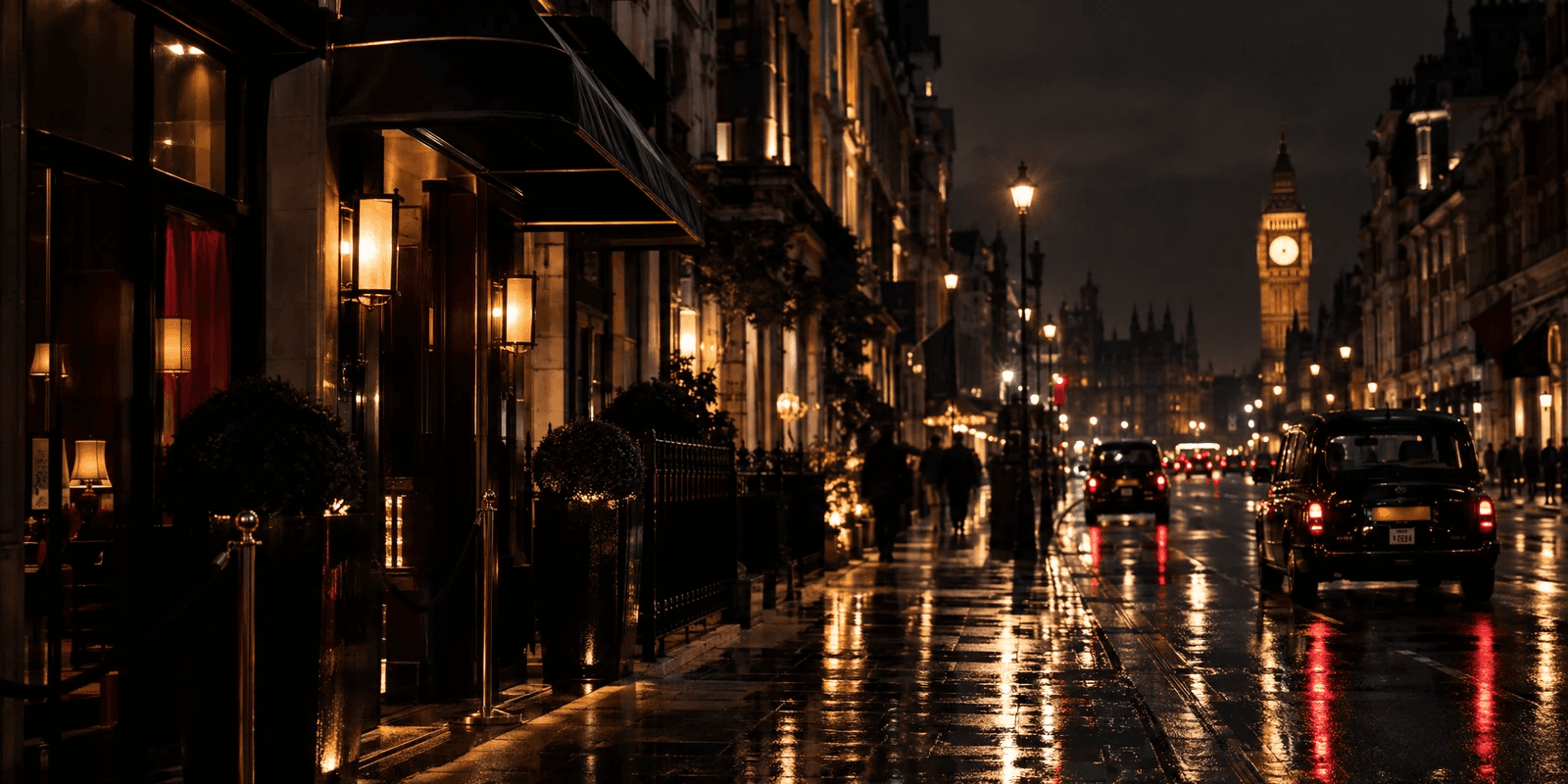
London after dark is not one night. It is four, stacked on top of each other, running to different clocks. The early evening belongs to Mayfair and to the offices emptying into it. Midnight is Soho’s and always has been. Between two and four the city narrows to a few lit doorways in Shoreditch, Vauxhall and King’s Cross, and everyone still out at that point meant to be. The rest of this is detail on that shape, plus the two things visitors consistently get wrong: how closely London watches, and how little it tells.
How the night is shaped, hour by hour
Six to nine is the most honest part of the London evening, because nobody is performing yet. Pavements outside pubs in the City, glasses held standing up, the whole thing over by half past eight. Restaurants take the handover. Theatre curtains go up around half past seven and come down near ten, which is why Soho gets a sudden tide at quarter past, all of it looking for a second act.
Then the shift. Somewhere around midnight London stops adding people and starts sorting them. Bars in the West End begin calling last orders, and the crowd splits three ways: home, a night bus, or a door with somebody standing at it. This is the hour when the city’s real hierarchy shows, because the places that are still filling are the ones that were never taking walk-ins.
At three, the map has shrunk to something you could memorise. Late-licensed rooms in Farringdon and east London. Vauxhall’s arches, which keep their own calendar entirely. Bar Italia on Frith Street with the football on. Beigel Bake on Brick Lane, lit like a chemist’s, selling salt beef to people in three different moods. Members’ clubs where the lights have come down but nobody has been asked to leave.
Five is when London gives up, and it does so more completely than Berlin or Madrid. That is a real difference, not a failing of nerve, and it comes down to licensing rather than appetite.
The districts, and what each one is actually for
Mayfair is a membership culture with streets attached. Berkeley Square, Hertford Street, Curzon Street, Dover Street: the addresses matter because the institutions are the addresses. Annabel’s, the casinos on Curzon Street and Hamilton Place, the bars at Claridge’s and the Connaught and the Dorchester along Park Lane. The register is money that has no interest in being seen being money. Doors have lists. Lists have staff who remember faces and have been trained not to react to them. Mayfair starts at seven and is largely finished by two, which surprises people who assume expense buys hours. It buys quiet.
Soho is the opposite arrangement and the better story. Old Compton Street is the queer heart of the city and has been for decades. Dean Street, Greek Street, Frith Street, Wardour Street: Ronnie Scott’s, the Groucho, Soho House, and a hundred rooms above a hundred restaurants. Soho also has membership, but the currency is what you have made rather than what you have inherited, and the doors are porous in a way Mayfair’s are not. Its old adult trade, the walk-up doors with handwritten first names by the bell, has been thinned by rent and redevelopment rather than by policing, and what is left sits alongside the delis and the jazz without much comment from either. The contrast with Mayfair is the whole point: one district buys discretion, the other manufactures it out of sheer density. Nobody in Soho can see you because everybody is busy.
Shoreditch runs later and cares less. Curtain Road, Rivington Street, Kingsland Road heading north. No dress code, which does not mean no door policy, and the door here is judging something harder to fake than a jacket.
King’s Cross is the most changed square kilometre in London. Within living memory it was a byword for the trade it now has no trace of; today it is Granary Square, Coal Drops Yard, the canal, and the hotel bars around St Pancras that stay civilised long after the last Eurostar. Worth walking simply for how thoroughly a place can be rewritten.
Chelsea goes to bed. King’s Road and Sloane Square do a dinner-led, residential evening that is genuinely good and genuinely finished by midnight. If the night you want begins at one, it does not begin here.
London and privacy: watched, and discreet anyway
London is among the most surveilled cities on earth. Cameras on most central junctions, number plates read automatically at the congestion and emission boundaries, contactless taps leaving a tidy record of where you entered and left. In infrastructure terms the city can reconstruct your evening.
And yet socially it is one of the most discreet capitals there is. Nobody asks who you are with. Hotel staff do not enquire beyond the booking name. Members’ clubs enforce no-photography rules with a seriousness that has nothing to do with etiquette and everything to do with what happens when they do not. The British press is aggressive and, since the hacking scandals and the settlements that followed, unusually careful about how it gets things.
That is the tension worth understanding. The state keeps records; the room keeps its mouth shut. Compared with New York after dark, where the doorman knows your business and the city talks about it, London logs more and says less. It scores high on our privacy dimension for the second reason, and the method behind that is set out in our editorial standards.
The legal position in England and Wales
This section is plain on purpose.
Selling sexual services, and paying for them, between consenting adults in private, is not in itself a criminal offence in England and Wales. A substantial ring of surrounding conduct is criminal:
- Loitering or soliciting in a street or public place for the purposes of prostitution, under the Street Offences Act 1959.
- Soliciting another person in a street or public place for sex, including from a vehicle, under the Sexual Offences Act 2003. Kerb-crawling falls here.
- Keeping, managing or assisting in the management of a brothel.
- Causing, inciting or controlling prostitution for gain.
- Paying for the services of a person subjected to force, threats or exploitation, which is a strict liability offence: the buyer’s ignorance is not a defence.
Two people working from the same premises can constitute a brothel in law, which means that working together for safety carries legal risk that working alone does not. That consequence is well documented and widely criticised, and it remains the position.
Scotland and Northern Ireland differ. Northern Ireland has criminalised paying for sexual services since 2015.
The above is a summary of the law as it stands in September 2026, not legal advice, and nothing on this site is. The Guides section covers the comparable position in other jurisdictions, and the Encyclopedia defines the terms.
London on the six dimensions
On the City Index, London is a high scorer that is not a high scorer everywhere, which is what makes it interesting rather than merely large.
Nightlife is deep and genuinely plural: several complete scenes that barely acknowledge one another. Luxury is near the global ceiling, carried by the density of hotels and private clubs within one postcode. Privacy is the paradox described above, and it is strong where it counts. The dating scene is informal, app-shaped and pub-anchored, slower and less declarative than Paris or Milan. Late night is the soft number, because licensing shuts a city of this size earlier than its appetite warrants. Alternative is strong, and lives south and east of everything discussed so far.
The comparative version of all this lives in Rankings, and the money question has its own page in what a night costs.
London will not seduce you at the door. It waits until the second drink, and then it is very good indeed.
Frequently asked questions
- Is paying for sex legal in London?
- In England and Wales, selling and paying for sex between consenting adults in private is not in itself a criminal offence. A ring of related activities is criminal, including soliciting in a public place, kerb-crawling, keeping or managing a brothel, and controlling prostitution for gain. This is a summary of the legal position, not legal advice.
- How late does London actually stay open?
- Most central bars call last orders between midnight and two, and clubs with late licences run to three or later, mainly in Shoreditch, Vauxhall and Farringdon. Hotel bars and private members' clubs go on quietly after that for the people entitled to be in them. On Friday and Saturday a handful of Underground lines run through the night; the rest of the week the night buses do the work.
- What is the difference between Mayfair and Soho at night?
- Mayfair sells privacy and charges an annual fee for it: doors with lists, rooms where nobody photographs anybody, an evening that starts and finishes earlier than you expect. Soho gives you the opposite kind of cover, which is a crowd. Both are membership cultures, but Mayfair asks what you have and Soho asks what you do.